Showing posts with label public VR. Show all posts

Wednesday, September 6, 2017

VRguy podcast episode: Kevin Williams discussing trends in out-of-home VR

Kevin Williams of KWP consulting and I spoke about out-of-home VR, including:

  • Longevity of VR cafe model
  • Single-experience vs configurable-experience sites
  • How much money would people pay for VR experience
  • and more

you can also compare this to what he said in late 2015

Tuesday, May 2, 2017

A Visit to the IMAX VR Center

A few weeks ago, I was in Los Angeles and decided to visit the newly-opened IMAX VR center. I went there as a regular paying customer - not some "behind the scene tour" - to see and learn. I've experienced Zero Latency, The Void and many others, so could not resist trying IMAX.

The lobby of the attraction is reminiscent of a small movie theater lobby. Vertically-oriented monitors on the walls announce the available VR experiences. A small reception area sells $10 tickets for the attractions. A display shows the available time slots for each 10-minute experience. After purchasing the tickets, a friend and I were asked to wait for our scheduled time. When the time came, an attendant escorted us to the VR area.

If I remember correctly, there were eight available experiences. Seven of them were based on the HTC VIVE. One - the John Wick Chronicles - was showing on Starbreeze headset. The HTC VIVE experiences did not appear to to be specially-made for this venue. For instance, one experience was Trials on Tatooine which can be freely downloaded from the Steam store. I think people come to movie theaters for an experience that they can't get at home. One would expect VR to be the same.

I have an HTC Vive at home (as well as many other headsets) at home. Using them is part of my job. However, most folks don't have easy access to PC-based VR equipment. For now, stock experiences might be just fine to get people exposed to VR.

Inside to the VR area, Each headset was in a space separated by low walls, a bit like an open space in an office. Headset cables were tied from the ceiling. HTC VIVE units had a leather face mask which is probably easier to clean. An operator administered each experience - one operator per headset. . Operators were friendly and enthusiastic about the VR equipment. I think their enthusiasm was contagious, which was nice.

Speaking of contagious, the operators told me that they wipe the face masks between users. Masks also get replaced every couple of weeks. I was told that visitors did not often complain about wearing a VR goggle that was used by many people before them.

I couldn't help but wonder about the economics. 15-minute timeslots: 10 minutes of usage plus some time to get people in and out of the experience. $40 an hour per station. One full-time operator per station. Now add rent, equipment, content fees, ticket sales, credit card fees, etc. Can you make money? Maybe making money is not the goal in this first location. Instead, the goal could be to have a "concept store" towards inclusion at the lobby of regular movie theaters.

Since I don't have a Starbreeze headset at home, I opted for the John Wick experience. It's a shooter game that encourages you to move in a space while holding a weapon. As expected, Virtual soldiers try to kill you. The headset was fairly light and the weapon comfortable. The experience was immersive though both the image and graphics quality could have been better. I can see why a person with little VR experience could enjoy these 10 minutes.

My friend did not have many VR experiences before this visit. He chose 'Trials on Tatooine" which he seemed to thoroughly like.

In all - a nice start to what can be the next big thing in entertainment.

Have you tried IMAX VR too? What did you think?

Sunday, April 9, 2017

The Unique Requirements of Public VR

A good treadmill for home use costs around $1000. A treadmill for use in a health club could be ten times more expensive. Why would club owners agree to pay so much more? Because they understand that the home equipment would not withstand the heavy use in a club.

The same is true for VR goggles. Goggles for home use are not suitable for sustained use in arcades and amusement parks. Both VR vendors and attraction operators need to understand and address these differences.

Durability is one key issue. A goggle in an amusement park is subject to both accidental and intentional abuse. A kid might try to see if a lens can pop out. Someone else might wish to take a component as a souvenir.

Hygiene is also important. VR experiences can be intense, and parks can be in hot and humid areas. Whether it is sweat, suntan lotion or something else, a guest does not wish to wear a soaked or dirty goggle. This is true not only for the face mask, but for any built-in headphones.

Sweat and humidity might also cause fogging on the lenses. If a guest has to take off the goggles to defog them, the break in VR immersion degrades the experience.

Depending on the attraction, visitors can be of all ages. Good physical fit is important, regardless if the visitor is a small kit or a large man. Goggles must accommodate a wide range of head sizes, and eye separation. Eyeglasses also present a design challenge. Visitors prefer to keep them on, so goggle vendors try to make room for them.

Beyond the customer-facing experience, there are important operational considerations. Attractions make money by providing a unique experience to a large number of visitors. Every minute spent by a guest adjusting straps in a roller-coaster, is a minute lost. Some have reported a 30% decrease in guest throughput after upgrading a roller coaster to VR. A larger park crew assisting guests or maintaining headsets means larger operational costs.

There are several different types of public VR experiences, each with unique challenge. A free-roam experience (e.g. Zero Latency) needs to address backpack PCs and controllers. Themed experiences such as The Void have accessories that supplant the story. These accessories have many of the same challenges. A small attraction in a shopping mall cannot afford a large operating crew. A VR roller coaster might need a chin strap to keep the goggles on the head. If a VR roller coaster relies on standard phones, they might overheat or need to recharge often.

Often, the first instinct of those building VR attractions is to do everything. They might try to build their own goggles, create content, or even a tracking system. Over time, they focus on their core competencies, bringing external vendors for everything else.

The first generation of these solutions show the immense promise of public VR. VR Coaster, for instance, has deployed GearVR-based roller coaster experiences in over 20 parks. These use a special tracking system to determine the position of each car at any time. The Void and Zero Latency use backpack PCs to allow guests to explore unique spaces. Talon Simulations provides flight and driving simulations in malls. IMAX opened a VR center where guests can try a variety of 10-minute VR experiences. Most of these first-generation solutions use consumer-grade hardware. Operators realize that many problems still need solutions. At the same time, consumers learn what they like and dislike in current solutions.

HMD vendors are also rising to the challenge. ImmersiON-VRelia has developed phone-based goggles that feature a reinforced plastic construction. Sensics released goggles with detachable face mask to address both hygiene and operational efficiency.

What's missing? Low-latency wireless video solutions to get rid of cables. Faster ways to adjust goggles for guest. Better methods to clean goggles between guests. Phones the don't overheat. Multi-user experiences with a stronger social aspect. The passage of time to see what works and what doesn't. VR standards to help integrate new devices into compelling experiences.

I am excited what public VR experiences could be. My excitement comes both from a user standpoint - these experiences are fun! - but also from a problem-solver view - the problems are challenging.

Try these experiences next time you can. Going to a movie theater provides a different experience than watching at home. Going through a good public VR experience is beyond what VR at home provides.

Wednesday, October 19, 2016

Peeking inside the Sensics Goggles for Public VR

Earlier this week, we made the Sensics Goggles for Public VR available for purchase on the OSVR Store. This is a limited pre-production run as we gear up for production of larger quantities.
We designed this product to address the needs of those that operate VR in public places such as theme parks, entertainment venues and shopping malls.
Goggles for public VR have different requirements than goggles for home use just like an exercise treadmill at a gym or health club needs to be different than a treadmill at home. Specifically, goggles for public VR need to be:
  • Durable, so that they withstand use by a large number of people. Unlike users of a VR goggle at home, users of a VR goggle at a public place might care less about handling it carefully.
  • Easy to clean, so that every user can get a clean, fresh feeling when wearing the goggles, regardless of who wore it before them.
  • Easy to maintain, in case something breaks.
  • Designed to allow maximum throughput of guests so as to maximize the number of people that can experience the attraction.
At the same time, the visual experience needs to be at least as good as goggles for home use because guests typically expect an experience beyond what they can get at home.
To achieve these goals, we used mass-produced 2160x1200 90 Hz OLED screens, high-quality dual-element optics with individual focusing mechanism, accurate 9-axis orientation tracker and incorporated them into a novel, patent-pending design. Below are some of the highlights of this design. To illustrate them, we mostly use the CAD drawings because they make it easy to show internal parts.
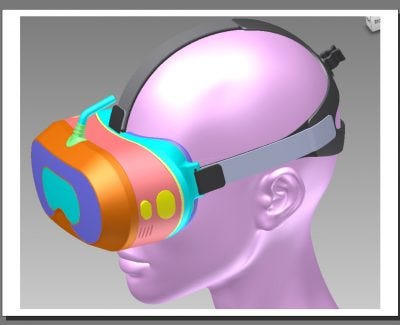
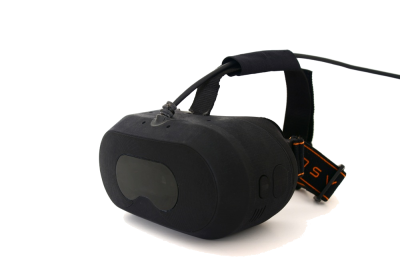
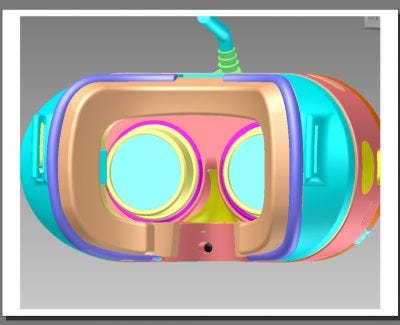
Here is CAD model of the entire unit (each part is colored differently in this model to make them stand out) next to the actual unit:
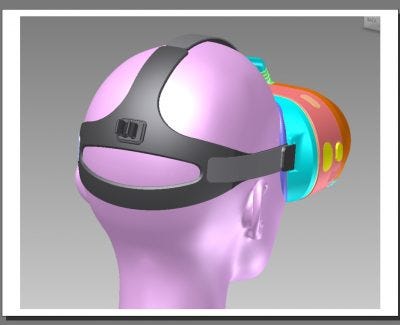
The back side of the unit has a cable clip to allow easy insertion and removal of cables as required. This ensures that cables don’t get in the way of the user.
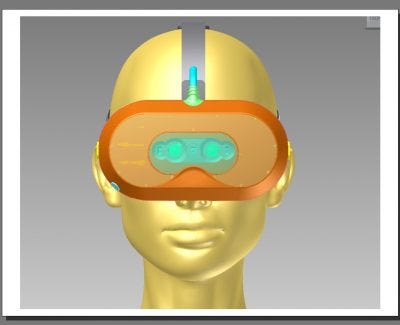
The front of the unit includes a window that is transparent to IR. This allows inclusion of a Leap Motion camera inside the unit to facilitate natural interaction with the hands. The fact that the controller is embedded inside the goggle eliminates the need to route cables externally. This approach is superior to external mounting of the controller because when mounted externally, the controller might be easier to detach from the goggles. Note that in the CAD model, the IR window has been removed so that the Leap Motion unit is clearly visible.
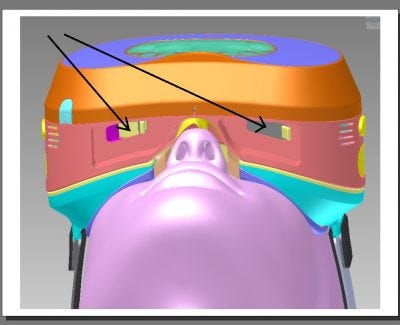
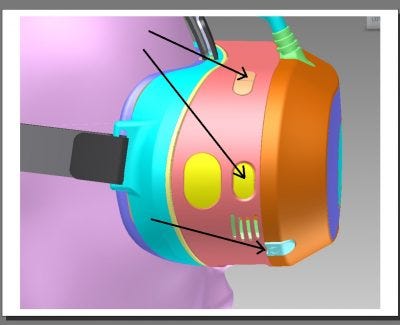
To fit a wide range of users, the goggles were designed with adjustable optics. These allow people that normally wear eyeglasses to take them off and still see an excellent picture. Individual knobs — highlighted by the arrows in the CAD drawing from a bottom view perspective
- allow focusing of each eye independently. It is also possible to design optics that have a large enough eye relief to accommodate glasses but we chose adjustments in this particular design.
The face mask — the part that touches the user’s face — is easily removable and replaceable. It is designed with a groove (not shown in the picture) that allows an operator to quickly and accurately replace the mask when needed without requiring any special tools.
VR experiences can be very intense. For instance, guests to SEGA Joypolis run around in a special warehouse and shoot zombies. It is important to keep these guests cool and dry. That’s why we the public VR goggles include dual silent fans that whisk away humidity and heat.
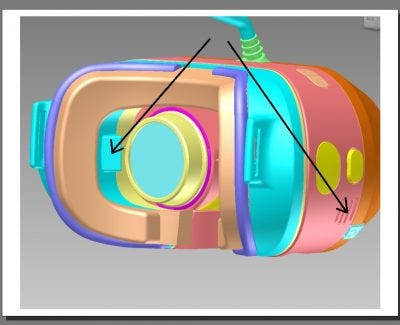
The diagram has arrows pointing to an air vent (one in each side) and the holes through which it exits the goggles. An important feature in the Sensics design is the ability to separate the “passive part” of the goggles (facemask and head strap) from the “active part” (electronics, optics, etc.). This feature provides several important benefits:
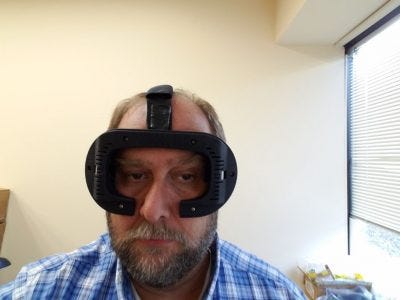
  1. It allows guests to don the passive part while waiting in line. They can adjust the fit to their heads, and make sure the strap is comfortable. While doing so, the front part of the passive unit is completely open so guests can still see the real world, take a selfie with the strap. Only when the activity is about to begin does the operator attach the active part to the passive part.
  2. It permits various cleaning strategies for the passive part — the part that touches the head. For instance, an attraction operator can have many more passive parts than active parts and then clean the passive parts in batch at the end of the day.
  3. Separating the face mask from the active part of the goggles allows for multiple sizes of the face mask to fit kids, different facial structures and so forth.
The two parts of the goggles — active and passive — are illustrated in the photos below by Sensics team member Yaron Kaufman.
Detaching the passive part from the active part is done by pressing two button — one in each side of the goggles. The button is shown as yellow highlighted by the arrow in the diagram. The clasp holding the two parts together is made of metal, and thus designed for numerous grab/release cycles.

Two additional parts are highlighted in the diagram: configurable buttons on the top right side of the goggles serve as programmable user-interface controls. This could be to increase/decrease volume, to pause the game, select a menu item or any other function. The mechanical design allows for one, two or three buttons per the preferences of the customer.
Last, an audio output jack appear on the bottom. The goggles can also support a permanent audio solution which attaches where the large yellow ellipse is shown in the diagram to the right. We put a lot of thought into designing this product. We hope you will get a chance to try it and appreciate its suitability to public VR applications.

Thursday, June 16, 2016

Notes from the Zero Latency Free-Roam VR Gameplay

I spent this past weekend in Australia working with Sensics customer Zero Latency towards their upcoming VR deployment at SEGA's Joypolis park in Tokyo. As part of the visit, I had the chance to go through the Zero Latency "Zombie Outbreak" experience and I thought I would share some notes from it. Zero Latency has been running this experience for quite some time and have had nearly 10,000 paying customers do it. The experience is about 1-hour long including about 10 minutes of pre-game briefing and equipment setup, 45 minutes of play and 5 minutes to take the equipment off and get the space ready for the next group. There are 6 customer slots per hour and everyone plays together in the same space at the same time. To date, Zero Latency has opened this to customers for about 29 hours a week - mostly on weekends - but will now be adding weeknights for a total of 40 game hours per week. A ticket costs 88 Australian dollars (about 75 US dollars) and there is typically a 6-week waiting list to get in. The experience is located in the Zero Latency office, a converted warehouse in the north side of Melbourne Australia. Most of the warehouse is taken up by the rectangular game space, about 15 x 25 meters (50 x 80 feet), or 375 m² (4000 sq ft) to be precise. The rest of the warehouse is used for two floors engineering and administrative offices.  One can peak through the office windows at the customers playing and during the day you can constantly hear the shouts of excitement, squeals of joy and screams of horror coming from the game space.

I had a chance to go through the game twice: once with a group of Zero Latency employees before the space was opened to customers, and once as the 6th man of a 5-person group of paying customers late night. Once customers come in they are greeted by a 'game master' that provides a pre-mission briefing, explains the rules and provides explanation on the gaming gun. The gun can switch between a semi-automatic rifle and a shotgun. It has a trigger, a button to switch modes, a reload button and a pump to load bullets into the shotgun and load grenades when in rifle mode. I found the gun to be comfortable and balanced, and it seems that is has undergone many iterations before arriving in the current form. Players wear a backpack that includes a lightweight Alienware portable computer, a battery and a control box. The HMD and the gun have lighted spheres on them - reminiscent of the PlayStation Move - that are used to track the players and the weapons throughout the space. Players also wear Razer headsets that provide two-way audio so that players can easily communicate with each other as well as hear instructions from the game master.

The game starts with a few minutes of acclimation where players walk across the space to virtual shooting range and spend a couple of minutes getting comfortable with operating their weapons. The game then starts. It is essentially a simple game - players fight their way through the space while shooting zombies and other menacing characters, some of which shoot back at you. Every few minutes, players switch scenes by going through an elevator or teleportation waypoints, circles on the ground where each of the six players has to stand before the next scene can be reached. Sometimes you fight in an urban setting, sometimes on a rooftop, inside a cafeteria and so forth. Zombies can be killed by a direct shot to the head or multiple shots to the body. The players can also be killed, but then return to the game after about 10 seconds of appearing as a 'ghost'.  Game 'power ups' are sometimes found through the space. For instance, during my gameplay I found an AK-47 assault rifle and later a heavy machine gun. At the end of the game, each player is shown their score and ranking, where the score is calculated based on the number of kills and the number of player deaths. That score sheet is emailed to players and is available for later viewing on the Web. The graphics are fine and an attacking zombie is quite compelling when it is right in your face, but the things I truly found compelling in the game are not so much the graphics and gameplay but rather a few other things:
  • Free-roam VR is great. The large space offers fantastic freedom of movement. You can see players move throughout the space, duck to take cover, turn around quickly with no hesitation at all. This generates an excellent feeling of immersion. You can truly feel that you could hide behind corners or walk anywhere with no apparent limitations. Of course, every space has physical limitations and Zero Latency has implemented a system where if you get too close to a player or a wall, something like a radar appears on your screen showing you at the center and the obstacles (players, walls) on it so that you know how to avoid them. If you get too close, the game pauses until you are farther away. This felt very natural. Throughout nearly two hours of active gameplay I think I brushed once or twice against another player but no more than that, even though players were in close proximity. Immersion is such that players don't notice people that are not players around them. In the current Zero Latency office, the bathroom for the office (the "Loo" in "Australian") is right across from the playing space so to get there you can either take a detour walking alongside the walls or go straight through the playing area where the players couldn't care less because they don't even know that you are walking by.
  • The social aspect is very compelling. This game is not about 6 individuals playing separately in a space. It is about 6 players acting as a team within the space. You can definitely hear "you take the right corridor and I'll take the left", or "watch your back" or "I need some help here!" shouts from one player to another. Players that work individually have little chance to stop the zombie invasion coming from all directions, but playing together gives you that chance.
  • Tracking - for both the head and the weapon - are very smooth to the point where you don't think about it. Because multiple players are tracked in the space you can see their avatars around you (sometimes with name tags). The graphics of players walking in the game need some work in my opinion, but you can clearly see where everyone is and what they are doing.
  • 45 minutes of game play go by very quickly and the game masters control the pace very well. As you can imagine, some groups take longer than others to get to the next waypoints, and the game uses waiting for elevators or helicopters as a way to condense or extend the total time. For instance, once you arrive in the cafeteria a sign shows up that the elevator will arrive in 100 seconds. I would imagine that if a group arrived earlier, they would have to wait longer for the elevator or if a group took more time, they would wait less.
The space itself is essentially empty save for the overhead tracking cameras. Thus, the same space the tracking system can be used for many different experiences. Unfortunately, we had to work from time to time and I did not have a chance to try some of the newer experiences that Zero Latency is working on, especially since the space was occupied by customers most of the time. I'm certainly looking forward to coming there again and continue to save the world.