A good treadmill for home use costs around $1000. A treadmill for use in a health club could be ten times more expensive. Why would club owners agree to pay so much more? Because they understand that the home equipment would not withstand the heavy use in a club.
The same is true for VR goggles. Goggles for home use are not suitable for sustained use in arcades and amusement parks. Both VR vendors and attraction operators need to understand and address these differences.
Durability is one key issue. A goggle in an amusement park is subject to both accidental and intentional abuse. A kid might try to see if a lens can pop out. Someone else might wish to take a component as a souvenir.
Hygiene is also important. VR experiences can be intense, and parks can be in hot and humid areas. Whether it is sweat, suntan lotion or something else, a guest does not wish to wear a soaked or dirty goggle. This is true not only for the face mask, but for any built-in headphones.
Sweat and humidity might also cause fogging on the lenses. If a guest has to take off the goggles to defog them, the break in VR immersion degrades the experience.
Depending on the attraction, visitors can be of all ages. Good physical fit is important, regardless if the visitor is a small kit or a large man. Goggles must accommodate a wide range of head sizes, and eye separation. Eyeglasses also present a design challenge. Visitors prefer to keep them on, so goggle vendors try to make room for them.
Beyond the customer-facing experience, there are important operational considerations. Attractions make money by providing a unique experience to a large number of visitors. Every minute spent by a guest adjusting straps in a roller-coaster, is a minute lost. Some have reported a 30% decrease in guest throughput after upgrading a roller coaster to VR. A larger park crew assisting guests or maintaining headsets means larger operational costs.
There are several different types of public VR experiences, each with unique challenge. A free-roam experience (e.g. Zero Latency) needs to address backpack PCs and controllers. Themed experiences such as The Void have accessories that supplant the story. These accessories have many of the same challenges. A small attraction in a shopping mall cannot afford a large operating crew. A VR roller coaster might need a chin strap to keep the goggles on the head. If a VR roller coaster relies on standard phones, they might overheat or need to recharge often.
Often, the first instinct of those building VR attractions is to do everything. They might try to build their own goggles, create content, or even a tracking system. Over time, they focus on their core competencies, bringing external vendors for everything else.
The first generation of these solutions show the immense promise of public VR. VR Coaster, for instance, has deployed GearVR-based roller coaster experiences in over 20 parks. These use a special tracking system to determine the position of each car at any time. The Void and Zero Latency use backpack PCs to allow guests to explore unique spaces. Talon Simulations provides flight and driving simulations in malls. IMAX opened a VR center where guests can try a variety of 10-minute VR experiences. Most of these first-generation solutions use consumer-grade hardware. Operators realize that many problems still need solutions. At the same time, consumers learn what they like and dislike in current solutions.
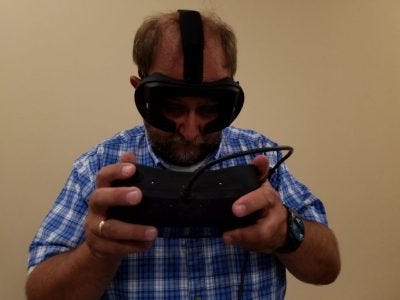
HMD vendors are also rising to the challenge. ImmersiON-VRelia has developed phone-based goggles that feature a reinforced plastic construction. Sensics released goggles with detachable face mask to address both hygiene and operational efficiency.
What's missing? Low-latency wireless video solutions to get rid of cables. Faster ways to adjust goggles for guest. Better methods to clean goggles between guests. Phones the don't overheat. Multi-user experiences with a stronger social aspect. The passage of time to see what works and what doesn't. VR standards to help integrate new devices into compelling experiences.
I am excited what public VR experiences could be. My excitement comes both from a user standpoint - these experiences are fun! - but also from a problem-solver view - the problems are challenging.
Try these experiences next time you can. Going to a movie theater provides a different experience than watching at home. Going through a good public VR experience is beyond what VR at home provides.
Yuval Boger (VRGuy) has been doing VR since 2006. He shares his experience and views on HMDs and VR technologies.
Also, check out the VRguy podcasts where I host industry experts for deeper conversations about VR and AR.
Showing posts with label amusement park. Show all posts
Sunday, April 9, 2017
Wednesday, October 19, 2016
Peeking inside the Sensics Goggles for Public VR
Earlier this week, we made the Sensics Goggles for Public VR available for purchase on the OSVR Store. This is a limited pre-production run as we gear up for production of larger quantities.
We designed this product to address the needs of those that operate VR in public places such as theme parks, entertainment venues and shopping malls.
Goggles for public VR have different requirements than goggles for home use just like an exercise treadmill at a gym or health club needs to be different than a treadmill at home. Specifically, goggles for public VR need to be:
- Durable, so that they withstand use by a large number of people. Unlike users of a VR goggle at home, users of a VR goggle at a public place might care less about handling it carefully.
- Easy to clean, so that every user can get a clean, fresh feeling when wearing the goggles, regardless of who wore it before them.
- Easy to maintain, in case something breaks.
- Designed to allow maximum throughput of guests so as to maximize the number of people that can experience the attraction.
At the same time, the visual experience needs to be at least as good as goggles for home use because guests typically expect an experience beyond what they can get at home.
To achieve these goals, we used mass-produced 2160x1200 90 Hz OLED screens, high-quality dual-element optics with individual focusing mechanism, accurate 9-axis orientation tracker and incorporated them into a novel, patent-pending design. Below are some of the highlights of this design. To illustrate them, we mostly use the CAD drawings because they make it easy to show internal parts.
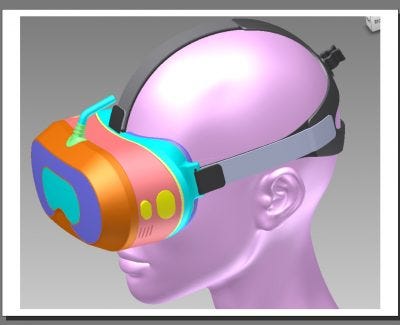
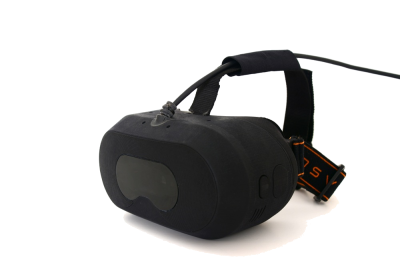
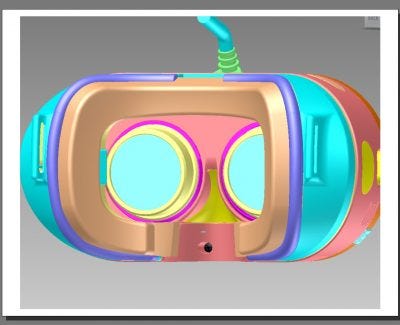
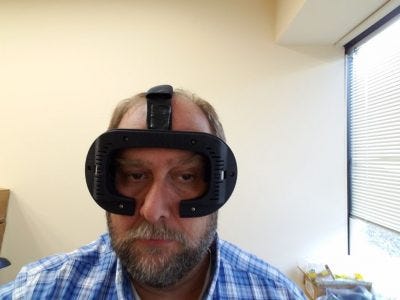
Here is CAD model of the entire unit (each part is colored differently in this model to make them stand out) next to the actual unit:


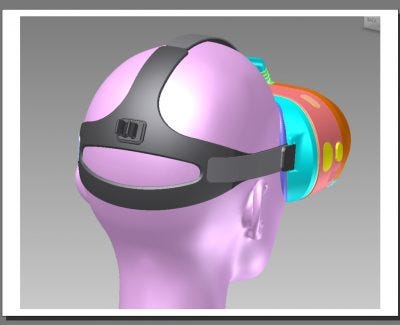
The back side of the unit has a cable clip to allow easy insertion and removal of cables as required. This ensures that cables don’t get in the way of the user.

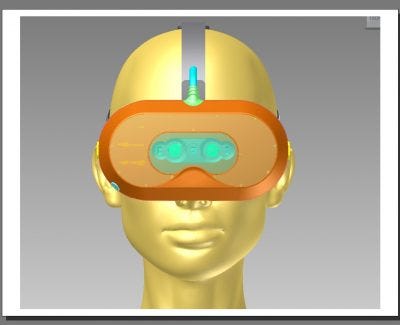
The front of the unit includes a window that is transparent to IR. This allows inclusion of a Leap Motion camera inside the unit to facilitate natural interaction with the hands. The fact that the controller is embedded inside the goggle eliminates the need to route cables externally. This approach is superior to external mounting of the controller because when mounted externally, the controller might be easier to detach from the goggles. Note that in the CAD model, the IR window has been removed so that the Leap Motion unit is clearly visible.

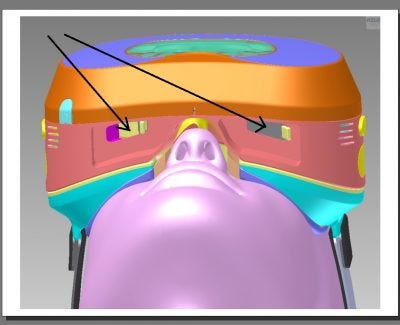
To fit a wide range of users, the goggles were designed with adjustable optics. These allow people that normally wear eyeglasses to take them off and still see an excellent picture. Individual knobs — highlighted by the arrows in the CAD drawing from a bottom view perspective
- allow focusing of each eye independently. It is also possible to design optics that have a large enough eye relief to accommodate glasses but we chose adjustments in this particular design.

The face mask — the part that touches the user’s face — is easily removable and replaceable. It is designed with a groove (not shown in the picture) that allows an operator to quickly and accurately replace the mask when needed without requiring any special tools.

VR experiences can be very intense. For instance, guests to SEGA Joypolis run around in a special warehouse and shoot zombies. It is important to keep these guests cool and dry. That’s why we the public VR goggles include dual silent fans that whisk away humidity and heat.
The diagram has arrows pointing to an air vent (one in each side) and the holes through which it exits the goggles. An important feature in the Sensics design is the ability to separate the “passive part” of the goggles (facemask and head strap) from the “active part” (electronics, optics, etc.). This feature provides several important benefits:
- It allows guests to don the passive part while waiting in line. They can adjust the fit to their heads, and make sure the strap is comfortable. While doing so, the front part of the passive unit is completely open so guests can still see the real world, take a selfie with the strap. Only when the activity is about to begin does the operator attach the active part to the passive part.
- It permits various cleaning strategies for the passive part — the part that touches the head. For instance, an attraction operator can have many more passive parts than active parts and then clean the passive parts in batch at the end of the day.
- Separating the face mask from the active part of the goggles allows for multiple sizes of the face mask to fit kids, different facial structures and so forth.
The two parts of the goggles — active and passive — are illustrated in the photos below by Sensics team member Yaron Kaufman.


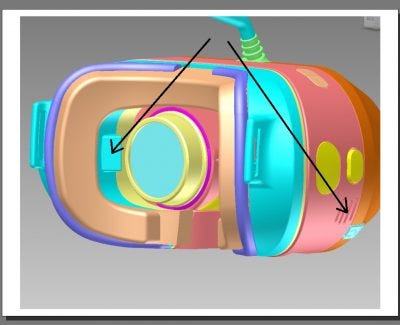
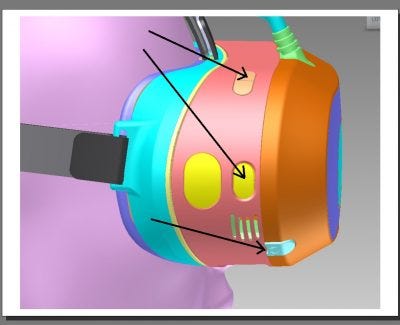
Detaching the passive part from the active part is done by pressing two button — one in each side of the goggles. The button is shown as yellow highlighted by the arrow in the diagram. The clasp holding the two parts together is made of metal, and thus designed for numerous grab/release cycles.
Two additional parts are highlighted in the diagram: configurable buttons on the top right side of the goggles serve as programmable user-interface controls. This could be to increase/decrease volume, to pause the game, select a menu item or any other function. The mechanical design allows for one, two or three buttons per the preferences of the customer.
Last, an audio output jack appear on the bottom. The goggles can also support a permanent audio solution which attaches where the large yellow ellipse is shown in the diagram to the right. We put a lot of thought into designing this product. We hope you will get a chance to try it and appreciate its suitability to public VR applications.
Monday, November 9, 2015
Using VR (and OSVR) in roller coaster rides and other out-of-home applications
![]() |
| Ubisoft Rabbids demo at E3 2015 |
Similarly, the notion of a VR cafe has also been raised. Just like in the 1990's when high-speed Internet access was not prevalent, a VR cafe would allow casual VR users to experience gaming VR without having to purchase a VR headset and a high-performance computer for home use.
There are several common requirements to all these use cases:
- VR goggles need to be rugged enough to withstand heavy use, accidental drops or the occasional teenager that tries to take it apart.
- Nearly-universal fit is needed so that little or no adjustment is required for a good VR experience. Some attractions will have an operator that can offer some assistance, but maintaining the throughput of an attraction is an important requirements.
- Need to be able to quickly clean and sanitize goggles between users. This might use a disposable face mask, or a way to quickly wipe down the headset.
In additional, some applications also require:
- Integration of the VR goggles into an existing frame (e.g. racing helmet for a racing simulator)
- Cable management
- Integration of other peripherals such a multi-person position tracking
Consumer VR headsets are not immediately suitable for these applications, though can definitely be used to prototype the initial design. On the other hand, building a completely new HMD and then creating a high-performance rendering infrastructure for it is also an expensive and time-consuming endeavor.
What to do? One option is to use OSVR for either the hardware and/or software portions of this effort.
Because OSVR hardware is open-source and designed to be hacked and changed, it is possible to take existing OSVR components - for instance the display, electronics and optics - and then package them as required to address the particular needs of the attraction.
Similarly, the OSVR software framework provides high-performance rendering and plugins for many game engines across a wide variety of operating systems, HMDs and peripherals. OSVR can also be extended to new types of HMDs if custom hardware is created.
My company can also help with creating semi-custom designs primarily based on pre-existing building blocks and with optimizing a software infrastructure to support a particular set of hardware peripherals
On a personal note, I had a chance to try a pre-production version of the VR ride at Europapark in Germany and it was quite an experience. During my visit, I tried the same ride twice: once with a track being shown in the virtual world (giving some hint of what turn or roll will happen next) and the other without it (making me feel like a pinball in space).
Out-of-home VR is becoming possible and cost effective, and that's an exciting development both for theme park owners as well as for showcasing VR to the public.
I'll be at the IAAPA show later this month in Orlando. If you want to meet and discuss some opportunities, drop me a note.
Subscribe to:
Posts (Atom)